[vc_row][vc_column][vc_column_text]
The future of the groundwater scenario in our country, in general, appears to be very bleak. There is no doubt that the water table in most parts of our country will continue to fall at the present level of groundwater extraction. The blanket moratorium under the Environmental Protection Act (1997) on the construction of new tube wells is logical and helpful, but this, at best, would merely stabilize the present level of extraction. However, it should be noted that there should be no such undue restrictions in areas that are rich in groundwater occurrence and are categorized as “Safe” zones.
The most important step required to improve groundwater availability in the country’s over-exploited regions (including semi-critical and critical) is to take up large-scale artificial groundwater recharge activities. Although the concept is well appreciated, any major initiative for large-scale construction of artificial recharge structures has remained neglected. In States where such programs are going on, the implementation may be said to be tardy at best. The usual emphasis of Government programs on low-cost designs and the high target is not very helpful. Unless there is an emphasis on quality and effectiveness, such efforts are likely to create many poorly functioning and rapidly deteriorating structures.
Conversion of an abandoned dug well into an artificial groundwater recharge (AGR) structure by connecting a rainwater collection channel through a silt retention pit is a makeshift arrangement. These structures may not be very effective, but there is no harm if these are done in large numbers and maintained by the farmers themselves. However, in large-scale national-level programs for constructing AGR structures under Government funding, the structures must be made more site-specific, effective and durable. Programs should also be designed to encourage the present groundwater users to construct compensatory AGR structures in their respective areas.
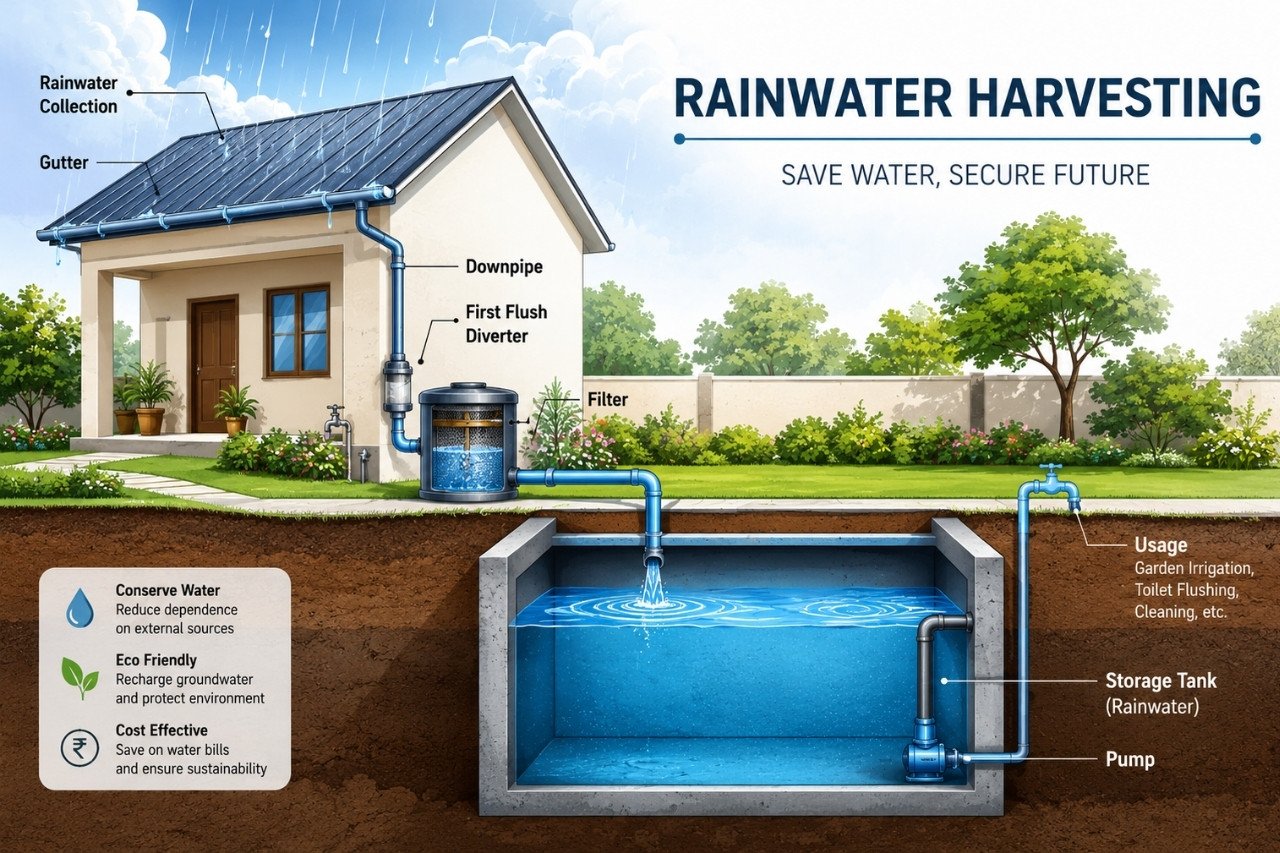
The presence of buildings and covered surface areas in metropolia do not allow much groundwater recharge as these produce high run-off. The urban run-off, known as stormwater generated in large volumes, usually goes away as wastewater. Arrangements should be made in all metropolises to collect and divert the stormwater into various parks and open spaces to form new water bodies. All the existing water bodies in urban areas should also be cleaned and maintained as these are a very important source of groundwater recharge. As consumption of stored rainwater is still not acceptable in most urban areas, the rooftops must therefore be used to collect rainwater and divert the same exclusively for groundwater recharge through an appropriate structure.
On the other hand, large-scale groundwater pollution has made a considerable quantity of freshwater permanently unsuitable for human use. Decentralized wastewater treatment plants must be installed in all industries, hotels, housing societies, and places of mass water consumption for recycling. Treated sewage and wastewater are to be used as far as possible for agriculture and similar other non-domestic use. Industries should bring in technologies to enhance water conservation and recycle treated water. All sewage and wastewater must be treated adequately before releasing into nearby rivers. Pollution control Acts for water should be implemented more vigorously to protect our rivers.
It should be mentioned here that nothing can be generalized in a country like ours. Groundwater has indeed been over-exploited in most parts of the country. However, this is not the case in some selected regions falling under large alluvium basins such as Ganga and Brahmaputra and similar other river basins. These areas fall under the “Safe” category as per groundwater zoning. Consequently, there should not be any undue restrictions in these areas for the construction of new tube wells nor any need for undertaking artificial groundwater recharge programs. More and more groundwater should be extracted from the flood-prone areas of Assam, West Bengal, Bihar, and Uttar Pradesh to create extra space within the groundwater reservoir.
[/vc_column_text][/vc_column][/vc_row]